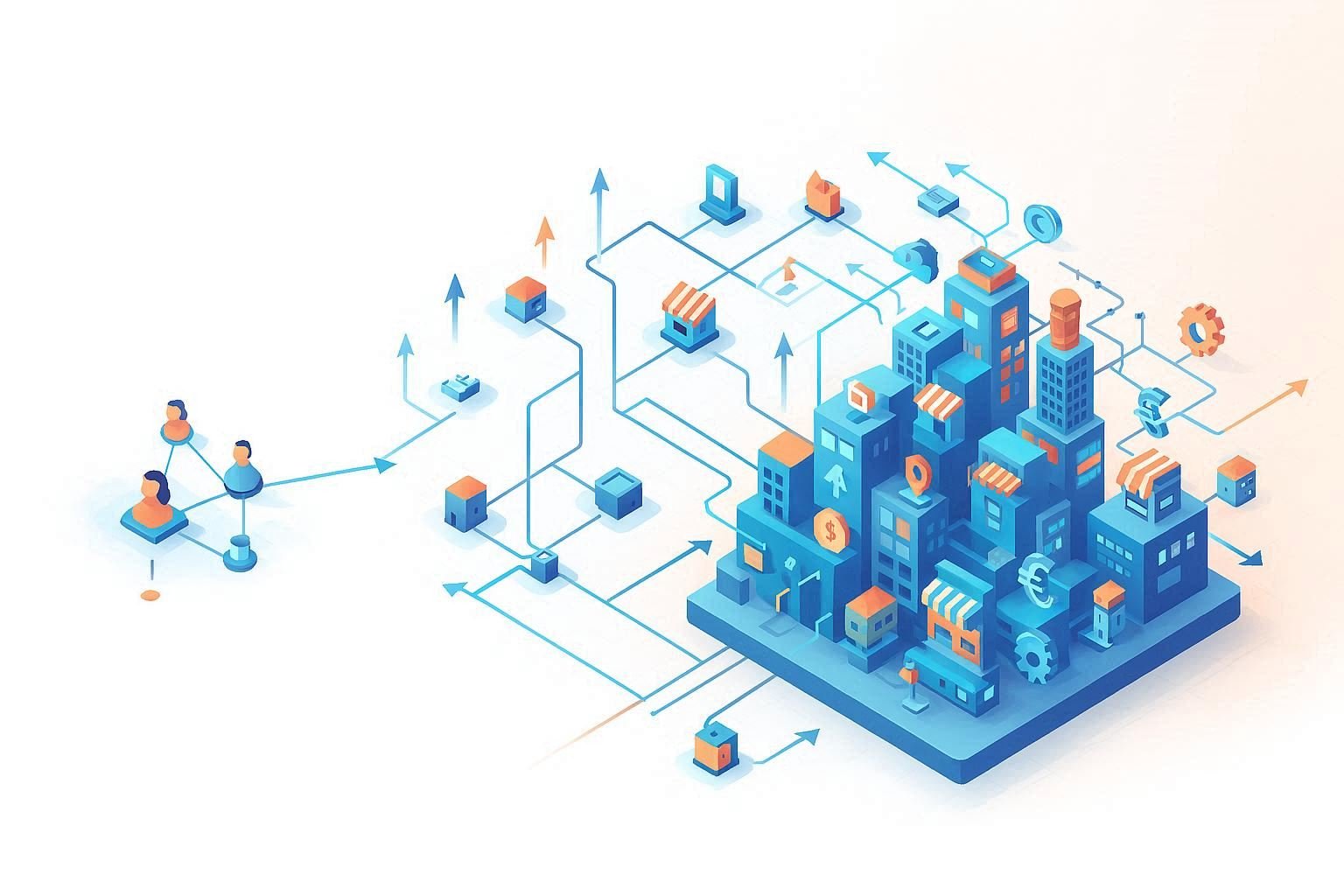

Complex markets emerge after adoption because the widespread use of a new tool or system creates a massive network of users that requires specialized services, secondary products, and infrastructure to function. This transition turns a simple invention into a layered economy where businesses no longer just sell the primary product, but instead provide the data, security, and maintenance that keep the entire system alive. When a technology moves from a few early users to the general public, the variety of needs grows so large that a single market splits into hundreds of smaller, connected niches.
From a Single Product to a Web of Services
When a new technology is first invented, the market is usually very simple. One company makes a product, and a small group of people buys it. However, as more people adopt the technology, the environment changes. This is often called the network effect. The more people who use a system, the more useful it becomes for everyone else. This growth forces the market to expand and become complex.
Consider the early days of the internet. In the beginning, people just wanted a way to send text messages or view simple pages. Once millions of people joined, the basic service was no longer enough. Users needed search engines to find information, security companies to protect their data, and web designers to build pages. Each of these needs created a new industry. The adoption of the internet did not just create a market for computers, it created a complex web of thousands of different types of businesses.
The Story of the Moving Machine
To see how this happens, we can look at the history of the car. When the first cars were sold, there was only a market for the machine itself. Most people still used horses, and there were no special roads for driving. Once the public began to adopt cars in large numbers, the world had to change to fit them.
A simple purchase turned into a massive ecosystem. Drivers needed a place to get fuel, which led to the growth of gas stations. They needed someone to fix the engines, which created the role of the mechanic. Governments had to build paved roads and create traffic laws. Insurance companies started offering policies to protect drivers from accidents. By the time cars were in every driveway, the market had become so complex that the car itself was just a small part of a much larger economic system.
Expert Views on Economic Evolution
Experts who study how economies grow notice that complexity is a natural result of success. W. Brian Arthur, a pioneer in the field of complexity economics, explains that an economy is not a static system that stays the same. Instead, it is a living thing that constantly rearranges itself. He suggests that when a new technology is adopted, it acts like a seed. As it grows, it creates “niches” for other technologies to fill.
Everett Rogers, who wrote about how innovations spread through society, noted that the late stages of adoption are very different from the early stages. He observed that as a product reaches the “late majority” of users, the market must provide more than just the product. It must provide “clusters” of related ideas and tools. Rogers mentioned that the social system around a technology determines how complex the market will become. If a technology changes how people live, the market around it will become more layered and specialized.
Data: The Growth of Secondary Layers
The following data illustrates how a market becomes more complex over time. It compares the number of people using a technology to the number of secondary service categories that appear to support them.
| Stage of Adoption | Total Users (Estimated) | Number of Support Industries | Market Complexity Level |
| Early Adoption | 500,000 | 2 | Very Low |
| Growing Interest | 5,000,000 | 12 | Moderate |
| Mass Adoption | 50,000,000 | 85 | High |
| Mature Market | 500,000,000+ | 400+ | Very High |
This table shows that for every large increase in users, the number of support industries grows at an even faster rate. This is because every new user has slightly different needs, and companies appear to meet those specific demands.
The Role of Specialization
As a market matures after adoption, companies stop trying to do everything. Instead, they specialize. In a simple market, one company might build a phone and also write all the software for it. In a complex market, one company makes the screen, another makes the battery, and a third company builds the operating system. Thousands of other small companies then create apps for that specific phone.
This specialization is a sign of a healthy, complex market. It allows for more innovation because a small company can focus on being excellent at one tiny thing. For example, a company might only focus on the security of mobile payments. They do not need to build the phone or the bank, they just provide the layer that connects them. This depth is only possible after mass adoption provides enough customers to support such a specific business.
Why Complexity is Unstoppable
It is impossible to keep a market simple once it becomes popular. People are different, and they use tools in different ways. Some people use a computer for art, while others use it for science or gaming. These different uses force the market to branch out.
Joseph Schumpeter, a famous economist, talked about “creative destruction.” This is the idea that new innovations replace old ones, but they also create a new structure. When a new technology is adopted, it destroys the old way of doing things. However, the new structure that grows in its place is always more complex than the one before. The new system must handle more data, more users, and more rules.
The transition from a single product to a complex market is a sign of progress. It means that the technology has become a part of daily life. While a simple market is easy to understand, a complex market is what allows an economy to grow and support millions of jobs.