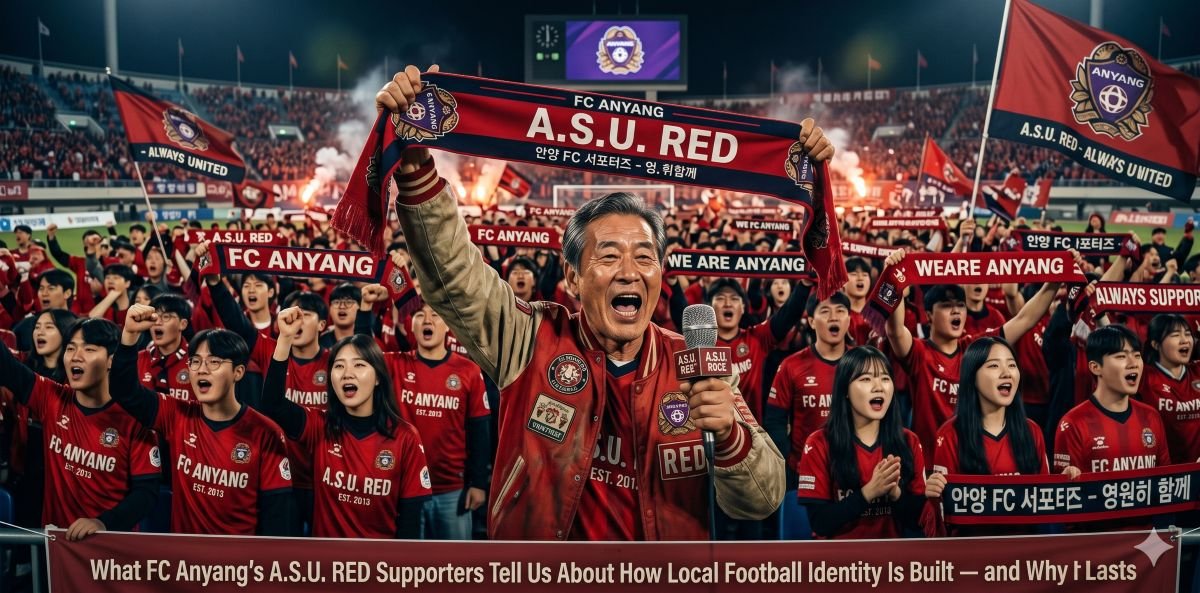

If you are new to Korean football and following FC Anyang for the first time — perhaps drawn in by their K League 1 debut in 2025 or their place in the Gyeonggi-do football conversation — you will quickly notice that the club’s supporters group, A.S.U. RED, behaves differently from the fan sections at most other clubs. The chants are distinct, the tifo culture is deliberately independent, and the emotional register of the support carries a weight that is unusual even by Korean football standards.
That weight has a specific origin, and understanding it tells you a great deal about how local football identity forms, how it survives institutional decisions it never agreed to, and how a supporter community rebuilds itself around something it chose rather than something it was given.
What A.S.U. RED Is and Where It Came From
A.S.U. RED stands for Anyang Supporters Union Red. The group did not begin with FC Anyang’s founding in 2013. It began much earlier, in the late 1990s, when the club then playing at the Anyang Sports Complex was called the Anyang LG Cheetahs.
The Cheetahs’ presence in Anyang was itself the result of a league policy rather than an organic football origin story. In 1996, as part of the K League decentralization policy, the three Seoul-based clubs were forced to relocate to satellite cities. LG Cheetahs moved 21 kilometers south to Anyang and became the Anyang LG Cheetahs. The policy was designed to spread professional football beyond the capital, and in Anyang’s case it worked — the club built a genuine local following, won a K League championship in 2000, and generated one of the era’s most meaningful rivalries with Suwon Samsung Bluewings, a contest rooted partly in the LG Group and Samsung Group’s corporate competition and partly in regional pride.
The fan group that formed around the Cheetahs during those years became the foundation for what would later reconstitute itself as A.S.U. RED. The connection between the original supporters community and the eventual civic club is direct: when FC Anyang was founded as a citizens’ club by Anyang City government in 2013, many of the people who had supported the Cheetahs during the 1996–2003 period reorganized around the new club.
The Departure That Defined Everything
The reason A.S.U. RED carries a particular emotional character — and the reason FC Anyang fans have a well-documented aversion to FC Seoul — is a single event: the 2004 relocation.
When the Seoul World Cup Stadium opened after the 2002 FIFA World Cup, Seoul Metropolitan Government needed a permanent tenant to offset construction and maintenance costs. Unable to establish a new franchise due to high stadium fees, the KFA approached existing clubs. The Anyang LG Cheetahs, with LG Group’s corporate backing, agreed to move back to Seoul. The club paid ₩15 billion in relocation costs, was renamed FC Seoul, and left Anyang without professional football for a decade.
The departure did not happen on good terms. Fans who had supported the club throughout its eight years in Anyang — who had celebrated the 2000 championship and attended matches through leaner seasons — had no meaningful voice in a corporate decision made above them. The Anyang Sports Complex, where the Cheetahs had played, sat empty for years. A short documentary made by Anyang citizens and members of the supporters’ group, titled FC Sukhavati, captured that period: the emptiness of the stadium, the years of abandoned support, and the eventual effort to build something new.
That documentary, and the experience it describes, is part of why the supporters who reformed around FC Anyang in 2013 were deliberate about building an identity that was independent of what had come before. A.S.U. RED developed chants that do not overlap with other K League supporter songs, tifo displays rooted in local visual culture, and a collective character that emphasizes community belonging over performance-based loyalty.
What Fan Identity Built on Grievance Actually Looks Like
For a newcomer to Korean football, it is worth understanding that the emotion FC Anyang supporters bring to fixtures against FC Seoul is not simply rivalry in the conventional sense. It is the product of a specific institutional decision that removed professional football from an entire city and left a community of supporters with nowhere to direct their investment.
When FC Anyang recorded their first win over FC Seoul in August 2025 — coming from behind in the 78th minute at Seoul World Cup Stadium — the response in the away end was not the celebration of a regular three points. The club’s own players and manager understood what they had delivered. Post-match remarks from multiple players explicitly referenced the supporters and the meaning of the fixture. The significance was not tactical; it was twenty years in formation.
The Line 4 Derby: A Regional Connection
For readers based in or around Ansan, there is a nearby parallel worth noting. Ansan Greeners FC and FC Anyang are connected by what is known as the Line 4 Derby — named after the Seoul Metropolitan Subway Line 4 that links Anyang and Ansan. Both are citizen-owned clubs in Gyeonggi-do, both have navigated K League 2 with limited corporate backing, and both have supporter communities built around local rather than corporate identity.
As examined in how Korean Generation Z sports fans engage differently with digital media based on their literacy level, the way younger Gyeonggi-do fans encounter and process club identity through digital platforms is changing. But the underlying community structures — the local grievances, the civic ownership models, the supporter groups that choose their own chants — are not digital phenomena. They are the product of decades of lived experience, and A.S.U. RED is one of the clearest examples of what that looks like when it has time to root itself properly.