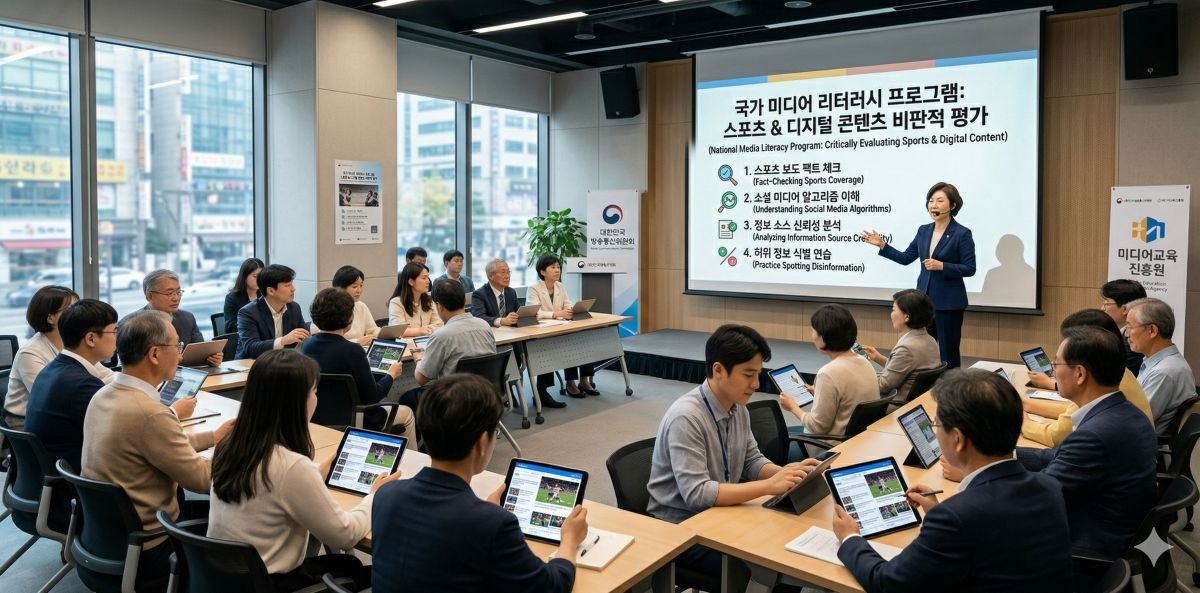

As of 2025, public discourse in Korea has been intensifying around media literacy education — driven by the widespread use of generative AI, the proliferation of disinformation, and the sheer volume of digital information Koreans encounter every day. For fans in Ansan who regularly consume sports content through YouTube, social media, and mobile apps, understanding what media literacy education actually teaches is more relevant than it might first appear.
Why Korea Is Investing in Media Literacy Now
As of 2025, public discourse in Korea is intensifying around the importance of media literacy education, in response to rapid developments such as the widespread use of generative AI, the proliferation of disinformation, and excessive exposure to digital information. The Korea Press Foundation (KPF), in collaboration with schools and educators, operates hands-on media literacy programs nationwide covering a wide range of topics — including news, video, advertising, and AI. These programs aim to strengthen the ability of students, teachers, and the general public to critically understand and respond to the digital environment.
The scale of the KPF’s effort is significant. In 2024 alone, more than 46,000 students participated in KPF programs, and over 900 schools are expected to join in 2025. In 2025 in particular, tailored instruction has been strengthened to address the needs of specific groups and learning levels, including AI literacy, customized lessons for multicultural schools, and media education for students with disabilities. Flagship programs include “Ronnie’s Media Explorers” for lower-grade elementary students and the “AI Literacy Classroom” for middle school students.
This is not a peripheral educational initiative. It reflects a structural response to the recognition that digital access alone does not produce informed media consumers — and that the gap between having a device and knowing how to evaluate what it shows is widening, not narrowing.
What the Programs Actually Teach
The KPF’s media literacy curriculum covers a range of competencies that go well beyond basic internet use. Through initiatives such as the fact-checking competition, Checkathon, for adolescents and a nationwide News Reading, News Diary Contest open to the general public, KPF supports both youth and adults in gaining hands-on experience in independently analyzing and presenting news and information. The foundation also operates a media educator certification system to train professional media instructors beyond schoolteachers, and has developed over 3,000 teaching materials and lesson plans tailored by age group and learner type.
The curriculum’s inclusion of AI literacy reflects a specific and growing challenge: the difficulty of distinguishing AI-generated content from authentic material. With the birth of AI, disinformation has entered a new era, requiring audiences to learn how to question sources, spot fakes, and become discerning consumers of news, social media, and information. AI has dramatically complicated the information landscape by rapidly generating and amplifying deceptive narratives, deepfakes, and AI-generated visuals.
The KPF’s approach also addresses the institutional side of the challenge. The Korea Press Foundation provides group training and conducts school visits, ensuring that instructors and resources are readily available to schools. In addition, the Ministry of Education has initiated government-driven programs aimed at enhancing media literacy skills among primary school teachers and supporting them to integrate media literacy into their pedagogical approaches.
The Ministry of Education has also integrated more media literacy and digital literacy content into the 2022 revised national curriculum, with new textbooks published from 2024 onward, including plans to distribute AI-embedded textbooks designed to transform classrooms into inclusive learning environments that meet the requirements of every student.
What This Means for Sports Content Consumers
For sports fans in Ansan and across Gyeonggi-do, the connection between media literacy education and everyday sports consumption might not be immediately obvious. But the same skills that KPF programs teach for evaluating news apply directly to how sports content circulates online.
Sports media is not immune to manipulation. Highlight clips can be selectively edited to misrepresent match outcomes. Statistics can be presented without context to support a narrative. AI-generated images and video — the same technology the K League deployed in its 2026 broadcast intro — can be used to fabricate or alter sports moments. Algorithmically curated feeds on YouTube and social platforms determine which sports stories a viewer encounters first, based on engagement patterns rather than accuracy or importance.
Digital literacy in the current environment must extend beyond basic skills. It requires the ability to critically assess content and recognize synthetic media. Key questions include: who created this content, why was it created, and what is the agenda behind it?
Critical literacy is more than evaluating information. It involves teaching audiences to question, analyze, and reflect on the messages they encounter every day — to pause, look deeper at what was created, who benefits from it, and how it may influence their understanding.
For a sports fan this translates practically. When a viral clip of a K League player surfaces on social media, a media-literate viewer asks: which outlet produced this, what was shown before and after, and does the narrative in the caption match what the footage actually shows? When a sports statistics graphic circulates, the question is whether the methodology behind the numbers is disclosed.
Core media literacy competencies include the ability to identify and address misinformation and disinformation, exercise safety and ethical digital practices, and raise awareness about the market ownership and economic business models of digital technologies — enabling citizens to advocate for transparency and accountability.
For readers in Ansan interested in how the psychological dynamics of digital engagement shape the way sports content is consumed and evaluated, ansaninsider.com has a useful examination of why equal rules in digital systems do not create equal experiences for all users.
The Gap Between Access and Competence
Korea’s investment in media literacy programs reflects a wider acknowledgment that connectivity does not automatically produce critical engagement. The country ranks among the world’s most digitally connected — and yet the KPF’s expansion of its programs signals that policymakers and educators recognize that access to information and the ability to evaluate it are fundamentally different things.
Research consistently shows a gap between people’s confidence in spotting manipulated content and their actual ability to do so — meaning audiences often trust instinct rather than evidence when evaluating digital media.
The skills that Korea’s national media literacy infrastructure is working to build — source verification, algorithmic awareness, AI content recognition, critical reading of statistics and framing — are the same skills that determine whether a sports fan in Ansan is an informed consumer of digital sports content or a passive one. For more on how confirmation bias shapes what digital audiences choose to believe when evaluating sports and media information, jejumonthly.com has explored the structural dynamics of how selective reasoning shapes digital engagement.
The programs the Korea Press Foundation runs are building precisely the capabilities that the digital sports media environment demands — and for fans across Gyeonggi-do, knowing those programs exist is itself a useful starting point.