
When a sports fan opens a comment section after a major match, they are not simply reading opinions. They are entering a behavioral environment that research shows operates by its own distinct emotional logic — one shaped less by individual judgment and more by the collective dynamics of a group that has been systematically amplified through platform architecture. Understanding how that environment works is useful for anyone who participates in online sports communities, particularly as the 2026 World Cup approaches and Korean fan engagement reaches one of its highest points in years.
A peer-reviewed study published in PLOS One and indexed by PubMed Central analyzed how digital media environments transform individual fan responses into collective emotional structures. Using data from 13,580 comments scraped from Chinese social platforms including Weibo, Xiaohongshu, and Bilibili, researchers applied grounded theory methodology to trace the process by which isolated fan reactions evolve into organized emotional communities — and what happens when those communities begin to reinforce themselves.
The Four-Stage Process From Individual to Community
The research identifies a consistent four-stage emotional arc across digital sports fan behavior: emotional arousal, emotional expression, emotional aggregation, and emotional community reproduction. Each stage builds on the previous one, and the transition from individual reaction to collective identity is not random — it is structurally facilitated by how digital platforms are designed.
The starting point is emotional arousal, and sports provides particularly fertile conditions for this. The study identifies three primary triggers: the competitive structure of sport itself, the symbolic weight of nationalism attached to international events, and the personal narratives constructed around athletes. These three elements combine to create what the researchers call an emotional catalyst — a moment or event that shortens the perceived distance between a fan and the subject of their attention, creating what they term proximal emotional attachment.
From there, the digital platform does what it is designed to do. Fans express their aroused emotions through comments, shares, and symbolic consumption — merchandise, fan club membership, hashtag participation. As more fans in a community express similar emotions simultaneously, individual responses begin to aggregate into a collective emotional posture. The group develops a shared identity, a sense of in-group coherence, and increasing differentiation from out-groups — namely fans of other athletes, other teams, or different perspectives on the same event.
Where Anonymity Becomes the Operative Variable
The fourth stage — emotional community reproduction — is where the research becomes most relevant for understanding the risks of digital fan engagement. Once a fan community has formed a cohesive collective identity, the emotional dynamics shift. The community no longer just reacts to events; it actively reproduces and reinforces its emotional character through ongoing interaction.
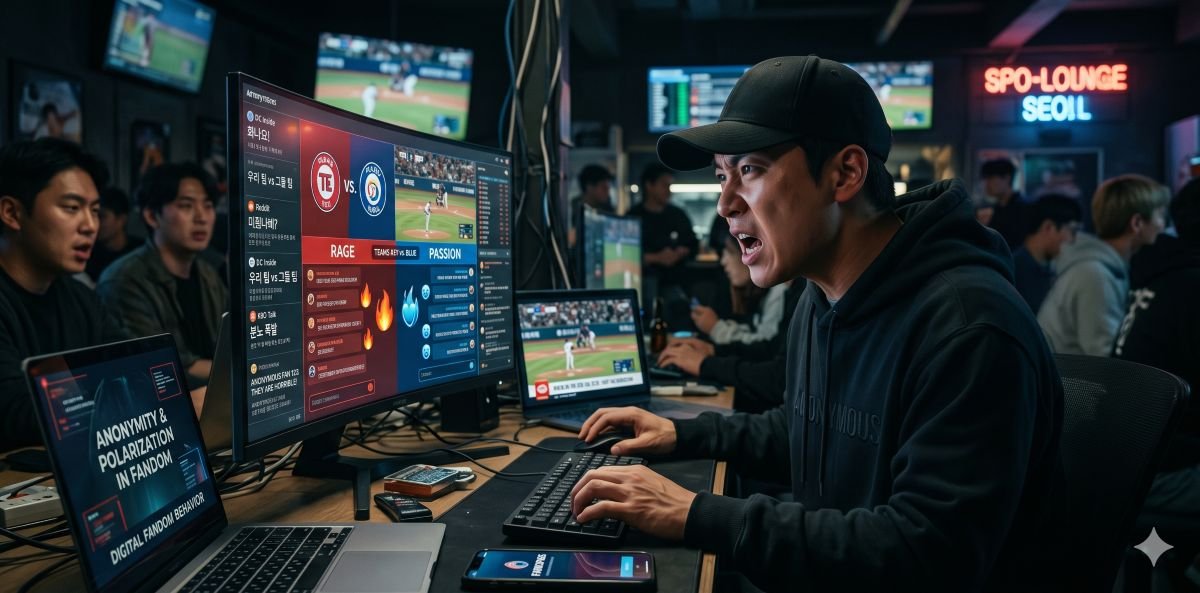
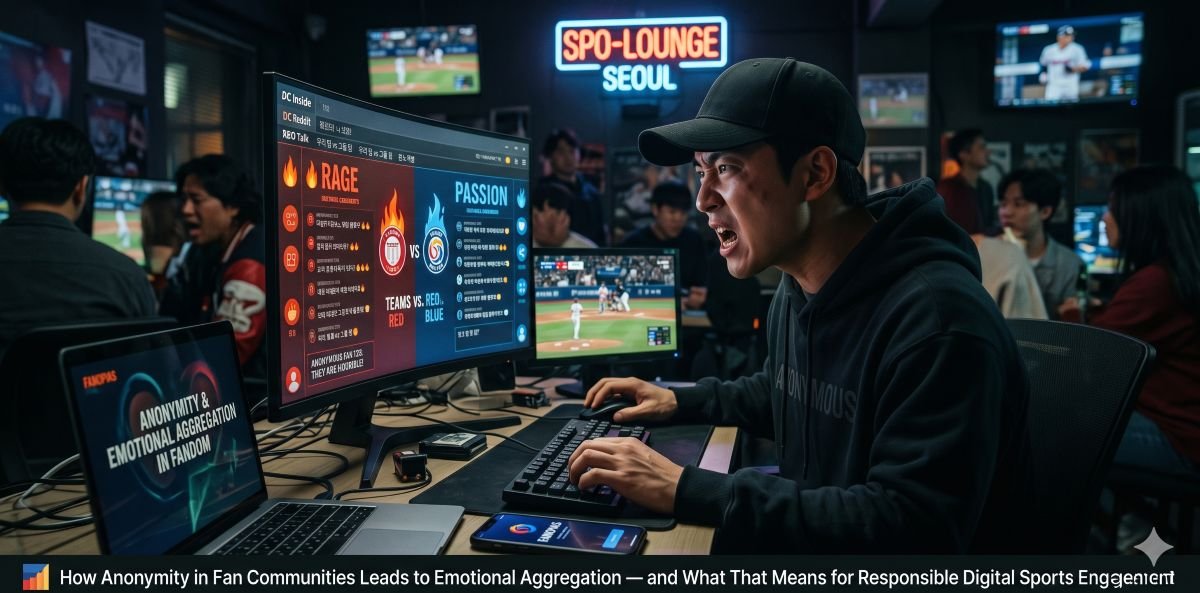
This is where anonymity introduces a structural risk. The researchers found that the anonymity afforded by digital platforms has a bifurcating effect on emotional community reproduction. On one path, anonymity can facilitate emotional resocialization — a process by which fans, freed from the social accountability of named participation, engage in more candid reflection, express doubt about group positions, and gradually develop more rational and inclusive behaviors. Anonymity, in this reading, creates space for honest disagreement within a community that would otherwise suppress dissent.
On the other path, the same anonymity intensifies emotional polarization. When fans can express hostility, outrage, or targeted criticism without facing social consequences, the inhibitions that moderate face-to-face behavior are removed. Comments that would not be made in a named context get posted, shared, and algorithmically surfaced based on their engagement metrics — which tend to favor strong emotional reactions over measured ones. The community hardens, in-group and out-group distinctions become more rigid, and inter-group conflicts escalate.
The 2021 Paris Olympics provided a well-documented example of this dynamic. During the women’s singles table tennis final, the online response to Chen Meng’s victory over Sun Yingsha included extreme hostility directed at Chen and her coach — behavior serious enough to prompt a formal statement from the Chinese Table Tennis Association. The researchers use this incident as a case study in how the emotional community reproduction process can generate outcomes that move far beyond sports fandom into targeted harassment and coordinated online aggression.
What This Means for Korean Sports Fan Communities
The structural dynamics described in the research are not specific to Chinese platforms. The same emotional architecture — arousal triggered by competition and athlete narrative, amplified by platform features, aggregated into collective identity, and reproduced through anonymous interaction — is present in Korean sports fan communities on platforms including Naver Café, KakaoTalk group chats, Twitter/X, and YouTube comment sections.
As discussed in why your sports feed shows you the same things — and what research says about how algorithms shape what fans see and believe, the recommendation systems governing what content surfaces in a fan’s feed are designed to maximize engagement — which in practice means prioritizing emotionally charged content over neutral or moderating responses. When a fan community is in a state of high emotional arousal following a controversial match result or a national team performance, the algorithm amplifies the most reactive voices while suppressing the measured ones.
This matters more now than at other points in the calendar. With South Korea confirmed in World Cup Group A alongside Mexico, South Africa, and Czech Republic, and with matches beginning June 11, the conditions for rapid emotional community formation and reproduction are already present. The competitive stakes are high, national identity is directly implicated, and Son Heung-min’s likely final World Cup appearance provides the precise kind of athlete narrative the research identifies as a primary arousal trigger.
Toward More Conscious Participation
The research is not an argument against fan communities. It is an analysis of how they structurally behave, and that understanding has practical value. Recognizing the emotional aggregation process for what it is — a sequence of platform-mediated behavioral steps rather than a spontaneous collective sentiment — creates the possibility of more conscious participation.
A fan who understands that their anonymous comment on a loss or a controversial call is not simply an individual expression, but a contribution to a collective emotional environment that the platform will actively amplify, has information that changes how they might choose to participate. The study’s finding that anonymity can facilitate resocialization rather than polarization is meaningful here: the same conditions that enable extreme behavior also enable the kind of honest, reflective engagement that can shift a community’s emotional trajectory toward something more constructive.