
The way younger sports fans engage with live events has changed substantially, and the research documenting that change points to something worth understanding carefully. It is not simply that younger audiences watch less — it is that the mode of watching has shifted in ways that carry specific risks for how information is processed, evaluated, and believed.
The Second Screen Is Now the Primary Screen
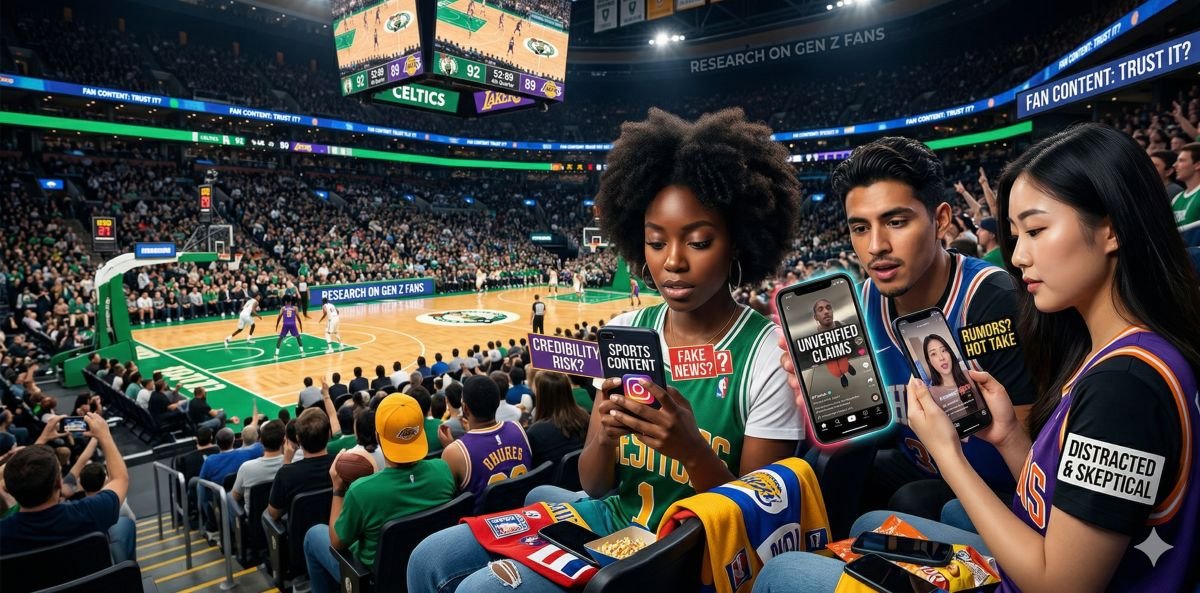
A Deloitte-Google report found that 93 percent of Generation Z sports fans use a second screen while watching live matches. That figure encompasses a wide range of simultaneous activity — checking real-time statistics, posting reactions on social media, reading commentary, watching replays on a separate tab while the main broadcast continues on another device. The second screen is not an occasional supplement for this generation. It is a structural feature of how they experience live sport.
This matters for a reason that goes beyond viewing preferences. When attention is divided between a live broadcast and a social media feed running in parallel, the cognitive capacity available for evaluating the credibility of information encountered on that secondary surface is reduced. The brain is already processing the match, tracking the score, reading a notification, and preparing a response. In that context, a piece of misinformation or a poorly sourced claim does not receive the deliberate scrutiny it would under conditions of focused attention.
Fragmentation Is the Dominant Pattern
The second-screen finding is part of a broader picture of fragmented sports consumption. A recent global survey found that just 31 percent of sports fans aged 18 to 24 watched live full-length matches, compared to 75 percent of fans aged 55 and older. Studies examining Generation Z viewing behavior more specifically found that only 58 percent of this cohort are willing to watch sports live from start to finish. The remaining 40-plus percent prefer to catch up through shorter content — key play clips, highlight packages, score updates, and recap videos on social platforms.
This is not necessarily a sign of diminished interest in sport. The same research shows that Generation Z fans are often deeply engaged with the teams and athletes they follow. What has changed is the format through which that engagement occurs. Rather than following a match in linear sequence over 90 or 120 minutes, many younger fans construct an understanding of the event through fragments encountered across multiple platforms over a period of hours.
The implication is that the entry point matters enormously. When a fan’s first encounter with the key moment of a match is a 30-second clip shared on a social platform — potentially stripped of context, potentially edited to emphasize a particular interpretation, potentially sourced from an account with no editorial standards — the mental model they build of what happened is shaped by that fragment rather than by the full event.
Short-Form Content as a Gateway — and a Risk
Research shows that 85 percent of Generation Z use short videos to find longer content they plan to watch later. This pipeline — short clip first, fuller engagement second — represents a specific credibility risk in the sports information environment.
Short-form sports content on social platforms is produced by an enormous range of sources. Official club accounts, credentialed journalists, amateur fan accounts, satire pages, deliberately misleading content farms, and AI-generated misinformation operations all produce clips and graphics that appear in the same feed, formatted similarly, and often indistinguishable in presentation quality. A fan scrolling quickly while also watching a match is not in a cognitive state optimized for source evaluation.
The behavioral dynamics that follow from this environment are well-documented. There is a consistent tendency to engage with content that confirms existing beliefs about a team, a player, or a result — and to do so quickly, before the source is checked. As sports journalism researchers have noted, the fastest way to spread a rumor is through a phone, and once that rumor is spread, it cannot be recalled. The willingness to believe things that affirm what one already wants to believe is a persistent feature of sports fandom that social media environments amplify rather than reduce.
Why Multi-Screen Engagement Compounds the Problem
The multi-screen pattern adds a structural layer to the credibility challenge. Research indicates that 83 percent of Generation Z viewers use multiple screens simultaneously when watching sports. Studies on second-screen use and brand recall found that multi-device engagement reduces both the quality of attention directed at primary content and the ability to critically evaluate secondary content encountered during that divided-attention state.
In practical terms, this means that the combination of shortened content and divided attention creates conditions in which misinformation, exaggerated claims, and poorly contextualized clips receive less scrutiny precisely at the moments when fans are most actively consuming sports information — during and immediately after live events.
For sports fans in Ansan and across Gyeonggi-do, where mobile-first content consumption is the norm rather than the exception, this pattern is not hypothetical. It describes how the majority of young people in the region encounter sports news, match updates, and sports commentary in their daily lives.
What Responsible Engagement Actually Looks Like
Understanding the behavioral pattern is the first step toward navigating it more effectively. A few structural habits help close the gap between fast consumption and reliable information.
Waiting before sharing or reacting to a piece of sports news — even briefly — creates space for basic source evaluation. Identifying whether a clip comes from an official club channel, a credentialed media outlet, or an anonymous account takes seconds and significantly changes the reliability of the information. Recognizing the difference between a highlight that shows what happened and a clip that editorializes about what it means is a skill that develops with practice but starts with awareness.
The credibility risks that emerge from fragmented, multi-screen sports consumption are not a reason to consume less content. They are a reason to consume it with slightly more deliberate attention to where it comes from and what it actually shows.
How confidence grows faster than understanding in information-saturated environments is a behavioral dynamic that extends well beyond sports. For analytical context on how engagement patterns and perceived understanding relate — and diverge — in digital information environments, Why Confidence Grows Faster Than Accuracy offers a useful framework that applies directly to sports media consumption.
For a broader look at how Korean Generation Z sports fans specifically engage with digital content and what media literacy research has found about variation in engagement quality, How Korean Generation Z Sports Fans Engage Differently With Digital Media provides directly relevant findings.