
For fans of the Ansan Greeners or any resident in Gyeonggi-do following their favorite team on a Saturday afternoon, the smartphone has become the “second screen.” We watch the match—either live at the Ansan Wa~ Stadium or via a broadcast—while simultaneously keeping an eye on a live score app.
Frequently, a strange phenomenon occurs: your phone pings with a “Goal” notification three seconds before you see the striker hit the back of the net on television. Or, perhaps more confusingly, a score appears on your screen and then suddenly vanishes or changes back.
To the casual observer, this feels like digital magic. In reality, it is the result of a massive, global infrastructure of human scouts, high-speed data pipelines, and automated systems. Understanding how this system works is the first step in becoming a more informed and responsible consumer of sports media.
The Source: The Human Element at the Stadium
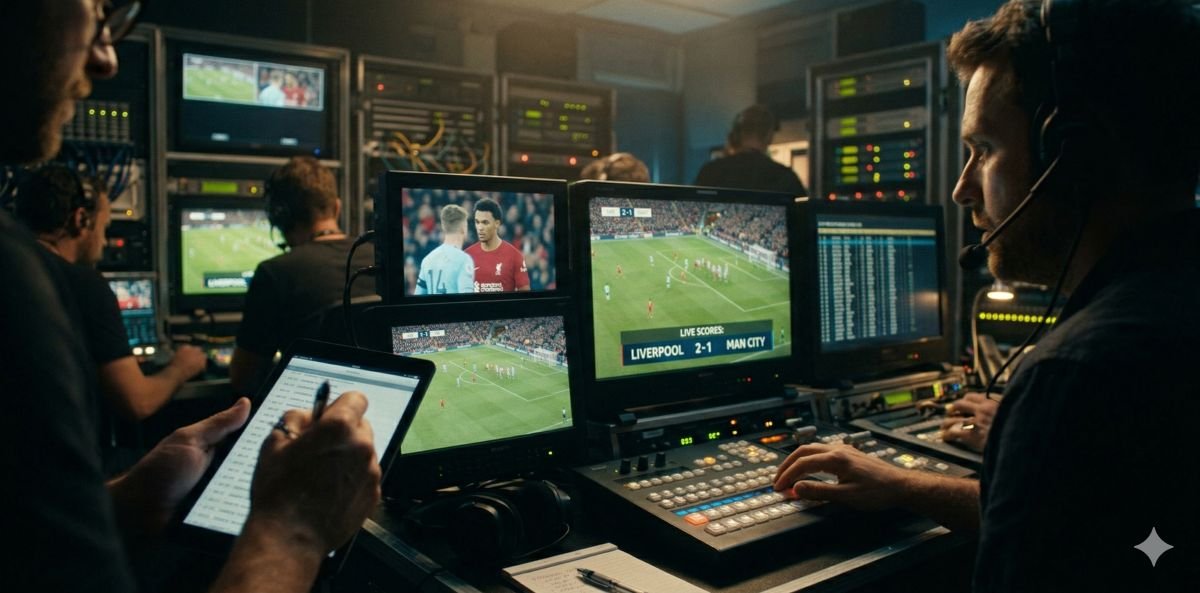
Despite the high-tech appearance of sports apps, the “Ground Zero” of live data is almost always a human being. Major sports data providers—such as STATSCORE or other global leaders—employ a network of professional “scouts” or data journalists who are physically present at the stadium.
When a goal is scored in an Ansan Greeners match, the scout at the venue taps a specific sequence on a specialized interface. This is not a standard consumer app; it is a high-speed logging tool designed for “ultra-low latency.” The scout isn’t just recording the score; they are logging the time, the player, the type of assist, and the location of the shot. This information is transmitted through a secure, dedicated connection to a central server in a fraction of a second.
Why Data is Faster Than Your TV
The reason your phone often “beats” your television is due to the nature of broadcast technology. Traditional TV signals—and especially digital streaming services—must go through a process called encoding.
The live footage is captured, compressed into a digital format, sent to a satellite or server, and then decompressed by your TV or phone. This process usually introduces a “broadcast delay” of anywhere from 10 to 40 seconds. The data feed, however, consists of tiny packets of text (e.g., “Goal: Player X, 42′”), which travel significantly faster than heavy video files. This discrepancy is a primary driver behind the data latency and information hierarchy in live markets, where the speed of information creates a tiered experience for different types of viewers.
The Pipeline: From Server to App
Once the scout’s data reaches the central server, it enters the Distribution Layer. Here, the raw information is “structured” into a format that thousands of different websites and apps can read simultaneously.
Validation: The system checks the data against other sources (such as official league feeds) to ensure accuracy.
API Integration: Fan platforms and media outlets subscribe to these “Data Feeds.” Their apps are constantly “polling” the server—asking for updates every few milliseconds.
Automation: When the “Goal” signal arrives, the app automatically triggers a push notification to your phone and updates the league table in real-time.
In 2026, this process is almost entirely automated. What used to require a team of graphic designers and manual data entry is now handled by algorithms that can update thousands of match pages across the globe in less than a second.
Why Errors Happen: The “Ghost Goal” Phenomenon
Every fan has experienced the frustration of seeing a score change only for it to be corrected moments later. These errors generally fall into three categories:
Human Error: In the heat of a fast-paced match, a scout may accidentally tap “Goal” when a ball hits the side netting, or “Red Card” for the wrong player.
Officiating Overrides: In the era of VAR (Video Assistant Referee), a goal might be scored, logged, and transmitted, only to be disallowed three minutes later. The data system must then “roll back” the state of the match, which can cause confusion on fan interfaces.
Conflicting Feeds: Different apps use different data providers. If one provider is slightly faster or slower than another, or if their scout makes a different interpretation of a “shot on target,” you may see conflicting statistics across different platforms.
Responsible Engagement in a Data-Driven World
As we rely more heavily on these digital systems, it is important for fans to maintain a level of “media literacy.” Real-time data is an incredible tool for engagement, but it is not infallible.
For the younger generation of fans in Gyeonggi-do, who are “digital natives,” the speed of information can sometimes lead to a false sense of certainty. We must remember that behind every number on a screen is a human observer and a complex series of technical handshakes.
Developing a foundational understanding of these systems helps fans manage their expectations and respond more calmly when technical glitches occur. As explored in our guide on how Korean Generation Z sports fans engage differently with digital media, being a “smart fan” in 2026 means looking beyond the score and understanding the infrastructure that brings it to your palm.
The next time you see that notification ping before the ball crosses the line on your TV, remember the scout in the stands and the thousands of kilometers of fiber-optic cable that worked together to beat the speed of light—just to keep you informed.